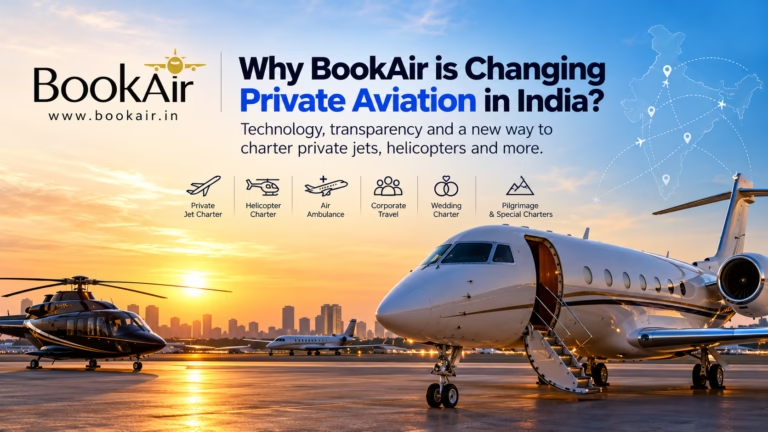
Private aviation in India is moving beyond luxury travel. A new generation of charter platforms is making private jets, helicopters, air ambulances and specialised charter services easier to discover, compare and coordinate. BookAir is one of the platforms building this new layer between passengers and India’s regulated charter aviation ecosystem.
For years, private aviation in India was perceived as a service available primarily to high net worth individuals, celebrities, politicians and large corporations. Finding an aircraft often depended on personal contacts, charter brokers, operators or a lengthy chain of phone calls.
That model is gradually changing.
Technology is making private aviation more accessible, more transparent and easier to understand. Instead of simply asking, “Which private jet is available?”, customers increasingly want to know which aircraft is suitable, where it is based, how long the flight will take, what positioning costs are involved, who operates the aircraft and what the final quotation actually includes.
This is where BookAir is attempting to build a different kind of private aviation experience in India.
What is BookAir?
BookAir is an Indian private charter and air ambulance coordination platform that connects customers with independent, DGCA regulated aviation operators.
Unlike an airline, BookAir does not operate a scheduled fleet of its own. Its model is based on coordinating customers with suitable charter and air ambulance operators.
This distinction is important.
A private aviation platform does not necessarily need to own aircraft to create value. In fact, the ability to work across multiple operators can allow a customer to receive aircraft options based on the actual requirement rather than being limited to one company’s fleet.
BookAir describes its approach around three ideas:
- Verified aircraft
- Vetted operators
- Transparent quotations
The company currently coordinates private charter, air ambulance, empty leg flights, wedding charter, VIP and campaign travel, pilgrimage related aviation and other specialised requirements across India. (BookAir)
Why India’s private aviation market needs a technology layer
Booking a commercial airline ticket is relatively simple.
You enter the departure city, destination and date, compare available flights and make a payment.
Private aviation is completely different.
There may be several aircraft capable of flying the same route, but the aircraft may be located in different cities. Passenger count, baggage, airport availability, operating range, positioning requirements, crew duty limitations and return requirements can all influence the final price.
This means private charter is not simply a matter of searching for a ticket.
It is a coordination problem.
For example, a customer travelling from a smaller Indian city may need an aircraft to first fly empty from another city before picking up the passengers. That positioning sector becomes part of the economics of the flight.
BookAir has built educational content around this problem, explaining why the location of an aircraft can significantly affect the final charter price. (BookAir)
This is one of the areas where technology and human coordination can work together.
BookAir’s biggest differentiator: it does not pretend private charter is like airline booking
One of the interesting aspects of BookAir’s model is that it does not try to hide the complexity behind a simple price tag.
Private charter quotations can contain several components:
- Aircraft flying time
- Positioning or ferry sectors
- Airport charges
- Landing and parking
- Ground handling
- Crew costs
- Overnight requirements
- Waiting time
- Catering and additional services
- Taxes
Two quotes that appear similar at first glance may therefore represent very different propositions.
BookAir’s charter quotation model focuses on showing the aircraft and the components behind the price rather than simply presenting one unexplained number. Its own charter guide explains why customers should examine positioning, airport charges, crew costs, waiting time, taxes and quotation validity before comparing charter options. (BookAir)
For a customer spending a significant amount on a private aircraft, that transparency can be more valuable than a flashy interface.
From Delhi Mumbai routes to smaller Indian cities
Another important development is the expansion of private charter beyond the traditional Delhi, Mumbai and Bengaluru business corridors.
India has hundreds of airports and airfields, along with a large number of cities where commercial connectivity may not always match the passenger’s schedule.
Private aviation can become particularly useful when:
- A business executive needs to visit multiple cities in one day
- A family needs to travel for a wedding
- A group needs to reach a remote destination
- A production company needs to move a team between locations
- A political campaign requires multiple stops
- A medical patient needs an urgent air ambulance transfer
- A group wants to combine road, helicopter and private aircraft travel
BookAir’s route database is designed around this wider geography.
Its published charter reference currently provides estimated flight times across 1,560 Indian routes, covering different aircraft categories including helicopters, turboprops, light jets, midsize jets and heavy or long range aircraft. (BookAir)
That type of information is useful even before someone decides to charter an aircraft.
For example, a customer considering a route between two Indian cities can first understand the approximate distance and aircraft category before requesting an actual quotation.
The aircraft does not always have to be a private jet
The phrase “private aviation” is often used interchangeably with “private jet”.
In reality, the right aircraft depends on the journey.
A short regional trip might make sense in a turboprop.
A longer business trip could justify a light or midsize jet.
A large group may require a larger aircraft.
A helicopter may be the better option when the destination is close to the actual worksite but far from a convenient airport.
This is why aircraft selection should start with the route and passenger requirement rather than with a particular aircraft name.
BookAir’s route pages illustrate this approach by showing different aircraft categories that can potentially serve specific city pairs. For example, its Bhopal to Goa route includes turboprop, light jet, midsize and larger aircraft options depending on the requirement. (BookAir)
Empty legs can change the economics
One of the more interesting areas in private aviation is the empty leg.
An empty leg is a repositioning flight that an aircraft needs to make without passengers. Instead of allowing the aircraft to fly completely empty, an operator may make that sector available to another customer at a lower price.
This can create an opportunity for travellers who have flexibility around their dates and timings.
BookAir includes empty leg coordination as one of its core services. The company describes these flights as repositioning sectors that can be offered at a discount when they match a customer’s travel requirement. (BookAir)
The catch is that empty legs are not equivalent to normal airline schedules.
The route exists because another charter already created the positioning requirement.
That means the timing and destination are largely determined by the preceding charter.
For flexible travellers, however, this can be one of the more interesting ways to access private aviation.
Safety and regulation matter more than luxury
Private aviation marketing often focuses on luxury interiors, leather seats, champagne and personalised service.
Those things may be attractive, but they are not the most important questions a customer should ask.
The first question should be:
Who is actually operating the aircraft?
In India, commercial charter operations fall under the regulatory framework of the Directorate General of Civil Aviation, including the Non Scheduled Operator Permit system.
BookAir states that it connects customers with independent operators and checks operator documentation before arranging flights. Its published material explains that operator vetting begins with a valid permit and extends to aircraft specific documentation. (BookAir)
This is an important distinction between a professional charter coordination platform and an informal aircraft marketplace.
A customer should always know:
- Which operator will operate the flight
- Which aircraft will be used
- Whether the aircraft is authorised for the operation
- Who the pilots are
- How maintenance is handled
- What happens in case of bad weather
- What happens if the aircraft becomes unavailable
BookAir has also published a practical checklist covering these questions for private charter customers. (BookAir)
Private aviation is also becoming a business productivity tool
For companies, the value of private aviation is not necessarily luxury.
Time can be the bigger consideration.
A senior executive visiting three cities in two days may lose significant productive time because of airline schedules, airport transfers and overnight stays.
A charter can allow a company to design the journey around its business schedule rather than fitting the schedule around commercial airline timetables.
This becomes particularly interesting for companies with recurring travel requirements.
BookAir has started addressing this through the concept of corporate charter programmes, where recurring routes and passenger requirements can be analysed to create a more predictable charter arrangement. (BookAir)
The potential advantage is not simply a cheaper hourly rate.
It can be:
- Faster planning
- More predictable availability
- Better aircraft matching
- Fewer unnecessary positioning sectors
- Simplified coordination
- Better use of executive time
For companies that regularly move leadership teams between multiple Indian cities, these factors can matter considerably.
Weddings are creating another private aviation use case
Indian weddings are increasingly becoming multi city events.
Guests may be travelling from Delhi, Mumbai, Bengaluru, Hyderabad, Ahmedabad, Kolkata and other cities to reach one destination.
The challenge is not simply arranging one flight.
It is coordinating people.
BookAir has built a dedicated wedding charter service around this requirement, including helicopter baraat entries, guest movement, multi function wedding circuits and same day return flights. (BookAir)
This is a good example of how private aviation is moving from being an individual luxury product to becoming an event logistics solution.
Instead of asking:
“Can I book a helicopter?”
The more useful question becomes:
“Can someone coordinate the entire aviation requirement for my event?”
That difference is significant.
VIP, political and production travel requires a different model
Some travel requirements are impossible to plan like normal commercial travel.
Political campaigns may require several stops in one day.
Film and television productions may move between locations according to changing shooting schedules.
Public figures may require greater privacy.
Corporate leadership teams may need standby aircraft because the itinerary can change during the day.
BookAir’s VIP and campaign charter service focuses on multi city routing, standby aircraft, advance coordination and limited sharing of passenger information with operating crews. (BookAir)
In such situations, the value of a charter coordinator is not simply finding an aircraft.
It is managing the moving parts around the aircraft.
Air ambulance is another side of private aviation
Private aviation also has an important role that has nothing to do with luxury.
Medical evacuation can require speed, aircraft suitability, medical equipment and coordination between hospitals.
BookAir also coordinates air ambulance requirements, including ICU equipped aircraft, trained flight paramedics and communication with sending and receiving hospitals. (BookAir)
This demonstrates how broad the private aviation ecosystem actually is.
The same underlying aviation infrastructure can support corporate travel, weddings, emergency medical transfers, pilgrimage travel, political campaigns and specialised logistics.
Technology does not replace aviation expertise
There is a temptation to think that a private aviation marketplace can simply be turned into an app.
It cannot.
Commercial aviation involves regulation, aircraft availability, weather, airport restrictions, crew limitations, permits, operational planning and real time changes.
Technology can make information easier to organise.
It cannot remove the operational complexity.
This is why BookAir’s positioning as a coordination platform is interesting.
The technology layer can help customers discover routes, understand aircraft categories, explore flight times and request quotations.
The human layer remains important for actually matching the requirement with an appropriate operator and aircraft.
That combination may be more practical than trying to completely automate the charter experience.
Transparency could become a major competitive advantage
The private aviation industry has historically operated through relationships.
A customer who knew the right broker or operator could often access aircraft quickly.
The problem is that this model can be difficult for someone entering the market for the first time.
How much should a Delhi to Goa charter cost?
Why is one quote twice as expensive as another?
Why is the same aircraft cheaper on one date?
Why does a short flight sometimes cost more than expected?
Why does the aircraft need to fly empty?
These are not obvious questions for a first time charter customer.
BookAir’s growing library of educational content addresses precisely these areas, including aircraft positioning, charter quotations, taxation, operator vetting, safety and flight time calculations. (BookAir)
That is potentially one of its strongest long term advantages.
An informed customer is easier to serve.
What makes BookAir different?
It would be too simplistic to say that BookAir is “winning” because it has aircraft or because it offers luxury travel.
Its more interesting proposition is the infrastructure around the booking.
1. Operator agnostic approach
BookAir connects customers with independent operators rather than restricting customers to a single owned fleet. (BookAir)
2. Transparent quotations
Customers can understand how the charter price is constructed instead of receiving only a single unexplained figure. (BookAir)
3. Broader aircraft selection
The requirement can be matched to helicopters, turboprops, light jets, midsize jets and larger aircraft depending on the route and passenger requirement. (BookAir)
4. Coverage beyond traditional luxury travel
The platform covers corporate travel, weddings, pilgrimage, VIP travel, campaign travel, air ambulance and empty leg flights. (BookAir)
5. Educational approach
Instead of only selling charter flights, BookAir is building information around the industry so customers can understand pricing, regulation, safety and aircraft selection.
6. Focus on coordination
The company describes itself as a coordination platform rather than an airline, which allows its service model to focus on matching requirements with independent regulated operators.
The bigger story is not just BookAir
The bigger story is what platforms like BookAir represent for Indian aviation.
India’s aviation market is becoming more sophisticated.
Consumers are increasingly comfortable researching expensive services online before making a decision. Businesses want faster procurement. Families want better event logistics. Medical institutions need rapid coordination. High value travellers want privacy and flexibility.
Private aviation is therefore becoming less about simply owning or hiring an aircraft and more about managing access to aviation capacity.
That creates an opportunity for technology companies.
Search engines can help customers discover charter options.
Route databases can help explain travel time.
Aircraft comparison tools can simplify selection.
Digital quotation systems can improve transparency.
CRM and communication platforms can coordinate passengers and operators.
Data can help identify positioning opportunities and potentially improve empty leg utilisation.
The company that brings these pieces together effectively may have a much bigger role in India’s private aviation ecosystem than a traditional broker.
What customers should look for before booking a private charter
Regardless of which company a customer chooses, there are several questions worth asking before making a payment.
Ask for the actual operating company
Know who will fly the aircraft.
Ask for the aircraft details
The aircraft type and registration should be clear.
Ask what is included
Clarify airport charges, positioning, waiting time, crew costs, catering and taxes.
Ask about the quotation validity
Aircraft availability can change quickly.
Ask what happens if the aircraft becomes unavailable
A professional charter provider should have a clear contingency process.
Ask about weather
The safest answer is always that the pilot and operator will make the final operational decision based on safety.
Do not compare only the headline price
A lower quote may not include the same services or may involve a different aircraft, schedule or positioning requirement.
These principles are particularly important because private charter is not a standardised airline product.
Is BookAir the future of private aviation booking in India?
It is too early to make that claim conclusively.
The private aviation market is complex, and success depends on much more than a website.
Aircraft availability, operator relationships, safety standards, customer service, technology, pricing and operational execution will ultimately determine whether a platform can scale.
But the direction is clear.
The traditional private charter experience is becoming more digital.
Customers increasingly expect to research before contacting a provider. They want transparent information. They want to understand what they are paying for. And they want a single point of coordination instead of dealing with multiple parties.
That is the space BookAir is targeting.
Rather than trying to turn private aviation into another airline booking website, BookAir is building a coordination layer around India’s charter aviation ecosystem.
And that may be the more realistic technology opportunity.
Final word
Private aviation in India is entering a new phase.
The next generation of customers may not necessarily begin their journey by calling a traditional broker. They may start with Google, compare aircraft online, check estimated flight times, understand positioning costs, read safety information and then request a quote digitally.
Companies that can combine technology with real aviation expertise will be in a strong position to serve that customer.
BookAir is an example of this emerging model.
Its proposition is relatively simple: help customers find the right aircraft, work with regulated operators, explain the economics of the flight and coordinate the journey from requirement to execution.
For an industry historically built around relationships and phone calls, bringing that process online could be one of the most important changes happening in Indian private aviation.
For private jet charter, helicopter charter, air ambulance and specialised aviation requirements across India, customers can explore BookAir or request a private charter quotation directly through its website.
Related BookAir resources
Readers interested in understanding private aviation further can also explore:
- Private Charter Services
- Private Jet Charter in India
- Charter Flight Times and Distances in India
- How to Read a Private Charter Quotation
- Understanding Aircraft Positioning Costs
- How Charter Operators Are Vetted
- Private Charter Safety Questions
- Wedding Charter
- VIP and Campaign Charter
- Air Ambulance
- 12 Jyotirlinga Yatra Charter